You have a dressing that needs to stay dry, you have found a barrier that should do the job, and now you are staring at five sizes wondering which one to order. Pick too small and water creeps in at the edges. Pick too big and the film folds over, sticks to itself, or won't lie flat on a curved arm.
The good news is that sizing comes down to one measurement and one rule, and you can do it with a ruler or a tape measure in a minute.
Quick answer: Measure the length and width of your dressing, including any tubing or caps that will sit under the barrier, then add 2 inches to each measurement. That leaves about 1 inch of bare skin on every side for the adhesive border. Choose the smallest HydroSeal size that is at least that big. For a PICC on the upper arm, the 7" x 9" HydroSeal Flex is usually the best fit.
Why size matters more than anything else
A barrier seals in one place only: the adhesive border where it touches skin. The middle of the film just has to drape over the dressing. So the question is never "will it cover the dressing?" but "will the border land on clean, dry skin all the way around, without touching the dressing?"
When a barrier leaks, it is very often because the border ended up on the edge of the dressing, on tubing, or on a fold of skin. Starting with the right size fixes most of that before it happens.
How to measure your dressing
- Measure the longest side of the dressing. Use the outer edge of the clear film, not the gauze or pad in the middle.
- Measure the shorter side. Again, outer edge to outer edge.
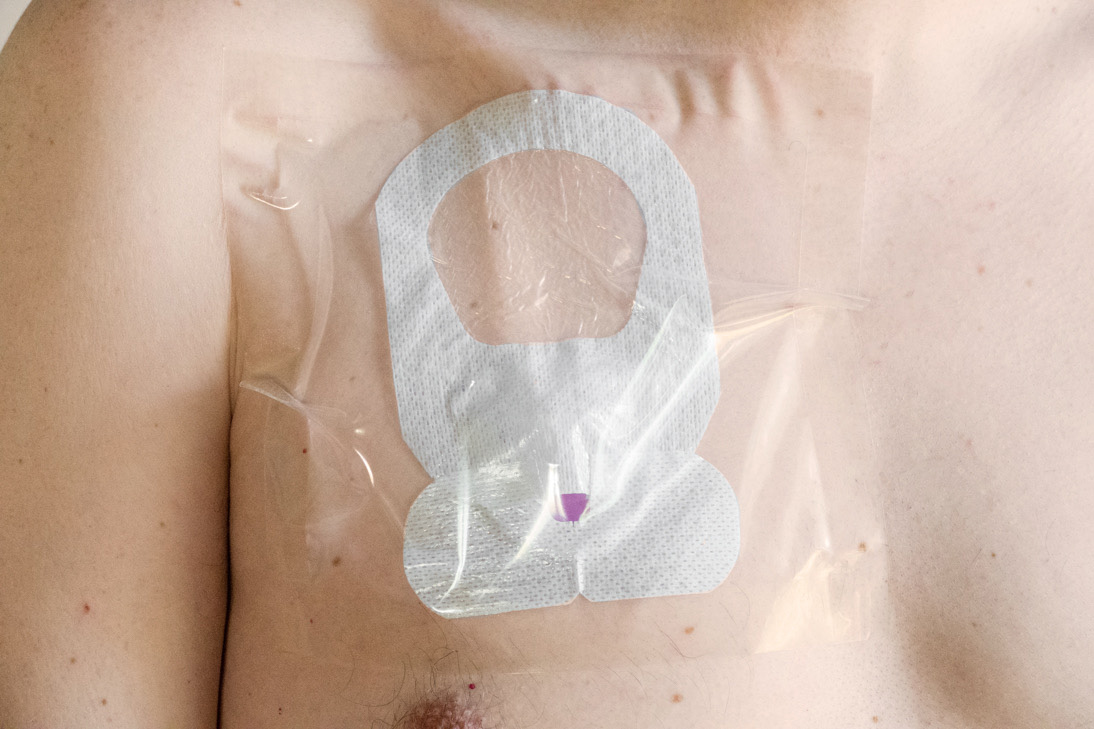
- Include anything that will go under the barrier. For a PICC or central line, coil the tubing and caps flat against the dressing the way you would before a shower, and measure the whole bundle. For an incision with a strip dressing, measure the full length of the strip.
- Add 2 inches to each measurement. That is 1 inch on each side for the adhesive border to sit on bare skin.
- Pick the smallest size that is equal to or larger than both numbers. If you fall between sizes, go up.
Example: a dressing that measures 4" x 4" needs a barrier at least 6" x 6", so the 7" x 7" is the right choice. A 5" x 7" dressing needs at least 7" x 9", which points you to the 7" x 9" Flex or the 9" x 9".
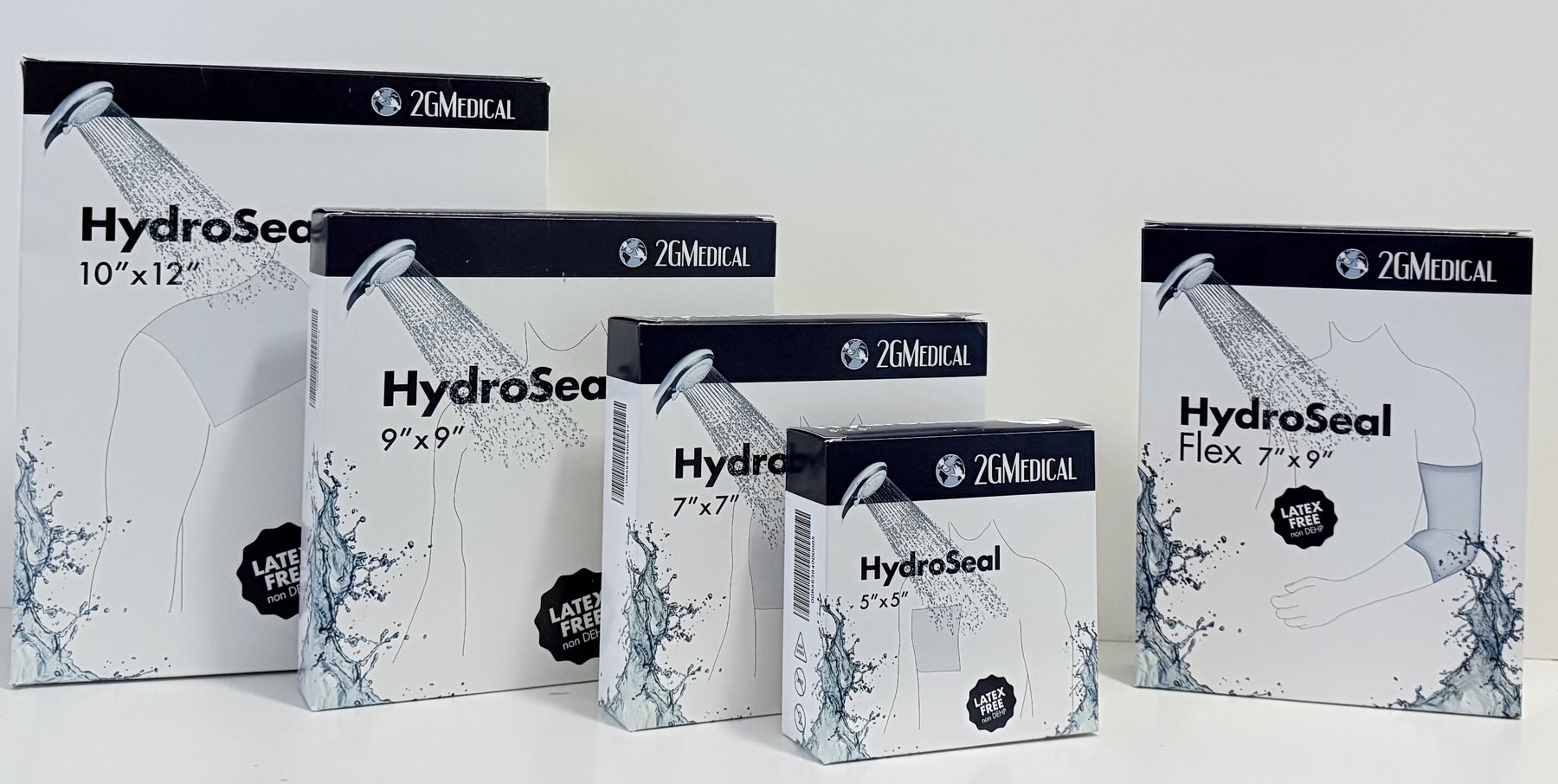
HydroSeal sizes at a glance
| Size | Product | Fits dressings up to about | Typical uses |
|---|---|---|---|
| 5" x 5" | HydroSeal Protective Barrier | 3" x 3" | Peripheral IV sites, small dressings, smaller children |
| 7" x 7" | HydroSeal Protective Barrier | 5" x 5" | Chemo port dressings, jugular or subclavian line dressings, many PICC dressings on a larger arm |
| 7" x 9" | HydroSeal Flex | 5" x 7" | PICC lines on the upper arm, sites where you need reach above and below without wrapping the limb, joints that move |
| 9" x 9" | HydroSeal Protective Barrier | 7" x 7" | Larger chest dressings, tunneled catheters such as Hickman or Broviac, dialysis catheters, shoulder or knee incisions |
| 10" x 12" | HydroSeal Protective Barrier | 8" x 10" | Long incisions: sternotomy, abdominal surgery, back or spine surgery, hip surgery, ostomy sites |
"Typical uses" is a starting point. Dressings vary a lot between hospitals and between patients, so your own measurement always wins over the table.
Which size for a PICC line?
This is the most common sizing question, and it has a specific answer. A PICC dressing sits on the inside of the upper arm, and you need to cover the insertion site, the dressing above it, and the tubing that hangs below. That calls for reach up and down the arm.
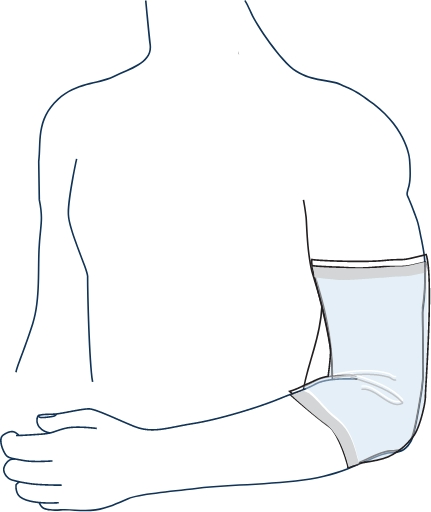
Clinicians used to reach for a 9" x 9" to get that coverage. The trouble is that on an average upper arm, 9" across wraps almost all the way around, and the film overlaps and sticks to itself. The HydroSeal Flex was made for exactly this: it is 7" wide and 9" long, so it covers above and below the dressing without overwrapping. Apply it with the 7" side horizontal and the 9" side vertical. The film is also stretchable, which helps on an arm that is bending and reaching.
If your arm is very slim, or you would rather not have adhesive on your skin at all, the HydroSeal Sleeve covers the whole arm and fastens with a buckle strap, so there is no size to choose. For the full shower routine, see how to shower with a PICC line.
Which size for a port or chest line?
Port dressings and jugular or subclavian line dressings are often around 4" x 4" to 5" x 5" once tubing is tucked in, which makes the 7" x 7" a common fit. Tunneled catheters with a larger dressing, or dressings close to the collarbone where skin curves, may need a 9" x 9". Measure first, then check the table. There is more on chest ports in showering with a chemo port.
Which size for a surgical incision?
Incisions are usually long and narrow, so length drives the size. Measure the full length of the dressing, add 2 inches, and size up from there. A sternotomy, a midline abdominal incision or a spinal incision will usually need the 10" x 12". A knee or shoulder dressing often fits a 9" x 9". If an incision is longer than any single barrier, ask your surgical team how they want it covered rather than overlapping barriers.
Getting a good seal once you have the right size
- The barrier goes over the intact sterile dressing. Never remove the dressing to apply it.
- Skin under the border should be clean and dry, with no lotion or cream. Shaving the area is not recommended.
- Use the tabs in order: top liner about 1" above the dressing, bottom liner about 1" below, then the two sides.
- Press the border down firmly, and don't lift and reposition it once it has touched skin.
- After the shower, towel the outside dry, then peel slowly from one corner. Each barrier is single use.
- Stop using it if your skin becomes irritated. All HydroSeal products are latex-free.
Frequently asked questions
Can I trim a barrier that is too big?
Trimming cuts through the adhesive border and leaves an edge that can't seal. Choose a size that fits rather than cutting one down.
Can I overlap two small barriers to cover a long incision?
Overlaps are where leaks start, because one border ends up stuck to film instead of skin. Use a single barrier that covers the whole dressing, and ask your team if nothing is big enough.
What if my dressing is on a curve, like a shoulder or elbow?
Size up slightly so the border has room to follow the curve, and smooth the film down without stretching it. The stretchable Flex film helps on joints that move.
How many should I order?
One per shower, since each barrier is single use. A pouch holds 7, which covers a week of daily showers. Facilities ordering in volume can request bulk pricing.