
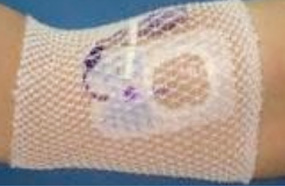
Every unit has the patient whose IV you have restarted three times since midnight. They are not trying to be difficult. They are confused, uncomfortable, and fixated on the unfamiliar thing taped to their arm. Each pulled line means another stick, delayed medication, a possible infiltration, and more nursing time on a shift that is already short.
For nurses and nurse managers, the question is how to protect the line without escalating to restraints. This guide pulls together the practical, non-restraint strategies that bedside teams use, with a focus on one simple principle: a line the patient cannot see or feel easily is a line they are less likely to pull.
Quick answer: Address the cause of the agitation, reassess whether the line is still needed, and site it away from the patient's reach when possible. Then cover the insertion site, tubing and connectors with soft tubular netting so there is nothing to see or pick at. Pair that with reorientation, family involvement and frequent checks before considering any restraint.
Why do confused patients pull out IV lines?
Pulling at a line is usually a response, not random behavior. Common drivers include:
- Delirium, which causes fluctuating attention and misperception. A line can feel like something foreign that needs removing.
- Dementia, where the patient may not remember why the line is there, even after repeated explanations.
- Discomfort at the site: itching under tape, a tight dressing, pressure from a connector, or an infiltration that hurts.
- Visual and tactile cues. Dangling tubing, a bright cap or a loose tape edge invite fidgeting.
- Unmet needs such as pain, a full bladder, thirst, hunger, or being cold.
- Developmental stage in pediatrics. Toddlers and young children explore with their hands and do not understand the risk.
Treating the line as the problem misses the point. Treating the line as a trigger points toward solutions.
Start with the basics: need, site and comfort
- Reassess the need. Ask at every handoff whether the line is still indicated. Could the medication go by mouth? Could intermittent access replace a continuous infusion? The most secure line is the one that has been safely removed.
- Choose a site with the patient in mind. Where clinically appropriate, an upper forearm site is harder to reach and easier to cover than the back of the hand or the antecubital fossa. For longer therapy, discuss with the team whether a different device is a better fit for this patient.
- Screen for and treat delirium. Use the screening tool your facility has adopted, and escalate to the provider so reversible causes are investigated.
- Check comfort at the site. Look for itching, moisture, tape irritation, or signs of infiltration. A line that hurts is a line that gets pulled.
- Secure per protocol. Use the dressing and securement device your policy specifies. Avoid layering extra tape, which adds itch and gives the patient an edge to peel.
Cover the line: out of sight, out of mind
Covering the IV is one of the simplest non-restraint interventions available. When the insertion site, tubing and connectors are hidden under a soft sleeve, there is less for the patient to notice, less to grab, and nothing to hook a finger under. It also protects the line from incidental snags on bed rails, gowns and blankets during repositioning.
A cover is not a restraint. The patient keeps full movement of the arm and hand. It simply changes what they see and feel.
ProNet is a pre-cut soft tubular gauze netting made for this purpose. It retains wet or dry dressings, replaces adhesive tapes and wraps for protecting vascular access devices, and helps keep PICC and peripheral lines from getting caught on items that could dislodge them. It conforms to pediatric and adult arms without constricting, and it is latex-free. Because it is pre-cut in 8" and 10" lengths, there is no hunting for scissors or cutting stockinette at the bedside.
Application tips for agitated patients
- Apply it at the time of insertion or the first dressing check, before the patient fixates on the line.
- Tuck connectors and any loop of extension tubing fully under the netting. An exposed cap defeats the purpose.
- Smooth folds so there are no ridges to pick at.
- Pull a gown sleeve or long-sleeve shirt over the top for another layer.
- Check perfusion distal to the sleeve and inspect the site per your assessment frequency. Covering the line must never mean not looking at it.
If the patient has fragile skin, a net sleeve also reduces the tape that would otherwise come off with it. See alternatives to medical tape for IV lines for more on that.
Other non-restraint strategies
Reorientation and routine
Keep clocks, calendars, glasses and hearing aids within use. Explain the line in short, calm sentences each time you approach. Keep a day-night rhythm with lights, activity and sleep protection.
Give the hands something else
Fidget items, a soft blanket, a folded washcloth or a familiar object can redirect busy hands. For children, play and distraction from child life staff or a parent work far better than repeated "don't touch."
Involve family and sitters
A familiar voice calms many confused patients. Teach family members to watch for picking and to redirect gently. Ask them to use the call light rather than adjusting anything themselves.
Route the tubing deliberately
Run IV tubing behind the patient or up the arm and away from the dominant hand rather than across the lap. Keep pumps and poles out of the patient's direct line of sight where safe.
Round with purpose
Regular checks for pain, toileting, position and thirst remove many of the reasons patients get restless in the first place.
Where restraints fit
Physical restraints carry well-known risks, and regulators and facility policies treat them as a last resort that requires an order, documentation, and ongoing monitoring. Before considering one, document which less restrictive alternatives were tried, including covering the line. If a restraint is used, keep working on the underlying cause so it can come off as soon as possible.
Building this into unit practice
For nurse managers, the goal is to make the simple steps automatic:
- Stock tubular netting where IV start kits live, so it is applied at insertion rather than after the first pull.
- Add "line covered and connectors tucked" to the IV assessment or handoff checklist for patients at risk for delirium.
- Track repeat restarts on your own unit to see where the problem concentrates, and review them in huddles.
- Include line covering in the unit's list of restraint alternatives.
For PICC patients going home, the same covering approach helps with daily life. Our patient guide on keeping a PICC line from snagging is a useful handout. Facilities stocking netting across units can request pricing through bulk orders.
Escalate to the provider or IV team if...
- A central line or PICC has been partially pulled out or the external length has changed. Do not advance it.
- There is bleeding, swelling, or signs of infiltration or extravasation at the site.
- The patient shows new or worsening confusion, which may signal delirium needing evaluation.
- Repeated dislodgement is delaying critical therapy.
Frequently asked questions
Is tubular netting considered a restraint?
No. It covers the line but does not limit movement of the arm, hand or body. Follow your facility's own policy definitions when documenting.
Does covering the line make it harder to assess?
Netting is open-weave, and it rolls back easily for a full look at the site. Build inspection into your rounding so covering never replaces assessment.
Should mitts be used instead?
Hand mitts can be appropriate for some patients, but many policies treat them as restrictive. Try covering the line and the other strategies above first, and follow your policy if mitts are considered.