
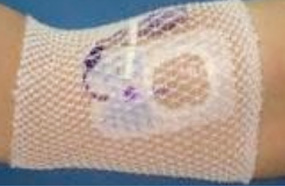
You go to pull on a sweater and feel a tug at your arm. Or you wake up and find the PICC tubing tangled in the sheet, the clear dressing lifting at one edge. Every catch makes you wonder whether the line just moved.
That worry is reasonable. A PICC line is meant to stay put for weeks or months, and the part that sits outside your skin is the part most likely to get caught. The good news is that most snags come from a handful of everyday situations, and each one has a simple fix.
Quick answer: Keep the external tubing covered and close to your arm so nothing can hook it. A soft tubular net sleeve over the dressing and tubing does this without adding tape to your skin. Dress the PICC arm first and undress it last, and use loose sleeves, a pillow at night and a little extra care around seatbelts, kids and pets.
Why does a PICC line get caught so easily?
The catheter itself runs inside a vein toward your heart, but a short length of tubing, the hub and one or more caps stay outside. That outside part is secured by a dressing and usually a securement device, but it still has edges and loops that can catch on a cuff, a zipper, a bedsheet or a small hand.
A single hard pull can move the catheter out of position or loosen the dressing. Even small, repeated tugs can work the dressing loose over a few days. That is why the goal is not only to avoid big yanks, but to keep the tubing from being exposed in the first place.
Cover the tubing with a soft net sleeve
A common way to protect a PICC is a short tube of stretchy gauze netting. It slides over the arm like a sleeve, holds the tubing flat against the skin, and gives clothing something smooth to slide over instead of a cap to hook.
ProNet is a pre-cut version made for this job. It is a soft tubular gauze netting designed to protect PICC and peripheral lines from getting caught on things that could pull them out, and to hold a dressing in place without tape. It conforms to adult and pediatric arms and does not constrict. It is latex-free and made in the USA, and comes in 8" and 10" lengths. Ask your infusion team whether they use it or something similar.
How to put on a net sleeve
- Wash and dry your hands.
- Check that the dressing is intact and the tubing is lying flat in its usual position. Do not reposition the catheter or securement device yourself.
- Gather the netting over your fingers, like you would a sock before putting it on.
- Slide it over your hand and up the arm until the dressing and the external tubing sit in the middle of the sleeve.
- Smooth it so it lies flat with no twists or rolled edges. Tuck any loose cap or hub under the net.
- Check that your fingers stay warm and pink and the net is not leaving deep marks. It should hold, not squeeze.
Change the net when it gets soiled or stretched out, and whenever your nurse changes your dressing.
Not for the shower: ProNet is gauze, so it soaks up water. Take it off before you wash, and use a waterproof cover instead. Our guide on how to shower with a PICC line walks through that step.
Getting dressed and undressed
Most snags happen while clothes go on or come off. A simple rule helps: the PICC arm goes in first and comes out last.
- Putting on a shirt: slide the PICC arm into its sleeve first, then the head, then the other arm.
- Taking off a shirt: free the other arm first, pull the shirt over your head, then ease the sleeve off the PICC arm.
- Pick roomy sleeves: short sleeves, loose long sleeves, or button-front shirts are easier than fitted knits. Avoid tight cuffs that roll up over the dressing.
- Watch zippers and buttons: jacket zippers and cuff buttons are common hooks. Hold the sleeve open as your arm passes through.
- Jackets and backpacks: a strap that sits on the upper arm can rub the dressing. Shift it or carry bags on the other side.
How to sleep with a PICC line without pulling it
Bedding is the second big culprit, because you move without thinking about it. A few habits help:
- Try sleeping on your back or on the side without the PICC.
- Rest the PICC arm on a pillow so it stays still and slightly raised.
- Keep the net sleeve on overnight so the tubing cannot catch on the sheet or pillowcase.
- If you share a bed, sleep with the PICC arm on the outside edge.
Seatbelts, car seats and travel
A shoulder belt can rub against an upper-arm PICC or press on the dressing. Ride with the line on the side away from the belt when you can. If that is not possible, place a small folded towel between the belt and your arm. Do not skip the seatbelt.
Kids with a PICC line
Children are curious and active, and they will pick at anything that looks interesting. Keeping the line covered helps the most, because a child cannot fiddle with what they cannot see or reach. A net sleeve under a long-sleeve shirt is a common setup.
- Give a simple, honest explanation: "This is your medicine tube. We keep it covered so it stays safe."
- Plan quieter activities for the PICC arm. Ask the care team which sports and playground equipment are off limits.
- Check the net and dressing at bath time and bedtime, since kids rarely mention a loose edge.
If bath time is your biggest worry, see our guide to bathing a child with a central line.
Pets and the PICC arm
A dog jumping up or a cat kneading your arm can catch the tubing in a claw. For the weeks you have the line:
- Keep the arm covered with the net sleeve and a shirt when pets are around.
- Let pets greet you on the other side.
- Keep pets off the bed at night if they tend to sleep against you.
Why not just add more tape?
It is tempting to tape the tubing down every time it feels loose. But extra tape can irritate the skin, and pulling it off later can tear skin or tug the line you were trying to protect. A net sleeve holds things in place with no adhesive at all. For more on this, read alternatives to medical tape for IV lines. Never add tape to the dressing itself unless your nurse tells you to.
Call your care team if...
- The line got pulled and the external tubing now looks longer than before.
- The dressing is lifting, loose, wet or soiled.
- You see bleeding, fluid leaking, redness, swelling or warmth at the site.
- You have new arm, shoulder or neck swelling or pain, or a fever.
- The line will not flush or an infusion will not run.
If the catheter ever comes partly out, do not push it back in. Cover the site, and call your team right away.
Frequently asked questions
Can I wear the net sleeve all day and night?
Yes, that is how it is usually used. Check your skin and fingers a few times a day, and replace the sleeve when it gets dirty or loose.
What should I do if my PICC got caught but looks fine?
Check that the dressing is still sealed and the tubing looks the same length as usual. If anything looks different, or you are not sure, call your infusion nurse. They would rather hear from you early.
Can I wear a compression sleeve or tight sleeve over my PICC?
Ask your care team first. Anything tight on the PICC arm should be cleared by them. A soft net sleeve is designed to hold without constricting.
Does the net sleeve replace my dressing?
No. It goes over your sterile dressing and helps hold it and the tubing in place. Your dressing is still changed on the schedule your team sets.