
If you care for an older parent, or your own skin has grown thin with age, steroids or illness, you may have seen it happen: the IV comes out, the tape comes off, and a strip of skin comes with it. Now there is a wound where there was only a line.
Tape is so routine in IV care that it can feel like the only option. It is not. There are gentler ways to hold a line and dressing in place, and some of them use no adhesive on the skin at all.
Quick answer: On fragile skin, use as little adhesive as possible. Let the primary dressing and securement device do their job, then hold everything else in place with a soft tubular net sleeve instead of extra tape. When adhesive has to come off, remove it slowly, low and parallel to the skin, and ask the care team about adhesive removers and silicone-based products.
Why does tape tear fragile skin?
Skin changes as we age. The outer layer thins, the bond between skin layers weakens, and there is less padding underneath. Long-term steroid use, poor nutrition, dehydration and some medical conditions do the same thing at any age.
Many medical tapes are built to hold strongly. On fragile skin, the adhesive can end up gripping the top layer of skin more firmly than that layer is attached to the rest. When the tape is pulled, the skin separates instead of the glue. Clinicians call this a medical adhesive-related skin injury, or MARSI. It includes skin tears, stripping of the top layer, blisters from tape that was stretched as it went on, and irritation from repeated taping in the same spot.
These injuries hurt, they can be slow to heal in older adults, and they create a new break in the skin right next to an IV site.
Who is most at risk of skin tears from tape?
- Older adults, especially those who bruise easily or have paper-thin skin on the forearms and hands
- People on long-term steroids or blood thinners
- Newborns and premature babies
- People with swelling, dry skin, or poor circulation in the arm
- Anyone who has already had a skin tear from tape
- Patients who need many IV restarts or frequent dressing changes in the same area
If any of these apply, mention it to the nurse before the IV goes in. It is a reasonable request, and it helps everyone on the team handle the arm gently.
What can you use instead of tape?
Some adhesive is usually unavoidable. The sterile dressing over the insertion site has to seal to the skin, and many lines also use a securement device. The goal is to stop there and avoid the extra layers of tape that pile up around the tubing, connectors and edges.
Tubular net sleeves
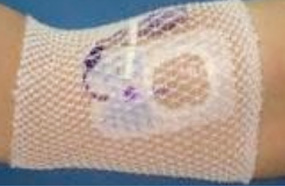
A tube of stretchy gauze netting slides over the arm and holds the dressing, tubing and connectors flat with gentle, even pressure. Nothing sticks to the skin, so there is nothing to peel off.
ProNet is a pre-cut tubular gauze netting made to replace adhesive tapes and wraps for protecting vascular access devices. It retains wet or dry dressings, keeps PICC and peripheral lines from catching on things, and conforms to adult and pediatric arms without constricting. It is latex-free and made in the USA. The pre-cut lengths (8" and 10") mean no cutting and no ragged edges.
Silicone-based tapes and dressings
Silicone adhesives are designed to release from skin more gently than many acrylic tapes. If tape is needed, ask whether the unit stocks a silicone option.
Skin barrier films
A no-sting barrier film, applied by the nurse before a dressing, puts a protective layer between the adhesive and the skin. Whether to use one, and where, is the care team's call, since some dressings should not have anything underneath.
Loose wraps instead of tight ones
Self-adhesive elastic wraps and rolled bandages can be wound too tightly, especially on a swollen arm. A net sleeve is easier to get right because it is sized to stretch without squeezing.
How to use a net sleeve on fragile skin
- Wash and dry your hands. Look at the skin around the IV for redness, bruising or existing tears so you know the starting point.
- Make sure the dressing is intact. Do not move or retape the catheter yourself.
- Gather the net over your fingers and open it wide so it does not drag on the skin as it goes on.
- Ease it over the hand and up the arm until the dressing and tubing sit in the middle.
- Smooth out folds and rolled edges. A ridge pressing into thin skin can leave a mark.
- Check circulation: fingers should stay warm and pink, and the net should not leave a deep pattern on the skin.
- To remove, roll the edge down gently and slide it off. Do not pull it along the skin.
How to remove tape without tearing skin
When tape does have to come off, how it is removed matters as much as what was used. These are the steps nurses are taught:
- Go low and slow. Fold the tape back over itself and peel it close to the skin, in the direction of hair growth, rather than pulling straight up.
- Support the skin. Press down gently on the skin just behind the edge of the tape as you peel.
- Use an adhesive remover. A medical adhesive remover loosens the bond so the skin does not have to give. Ask the team which one is approved.
- Do not rip. Fast removal is what causes tears on fragile skin.
If a skin tear does happen, do not try to pull the flap off. Tell the nurse so it can be cleaned and dressed properly.
Other ways to protect fragile skin around a line
- Keep skin moisturized away from the IV site, as your care team allows. Do not put lotion where a dressing needs to stick.
- Pad bed rails and wheelchair arms that the IV arm bumps against.
- Choose loose, long sleeves for an extra layer of protection.
- Avoid lifting or turning someone by gripping the forearm.
- Rotate where any necessary tape goes, rather than taping the same spot each time.
A covered line is also a line less likely to get pulled. For more on that, see how to keep a PICC line from snagging. If the person you care for is confused and picks at the IV, preventing IV dislodgement in confused patients covers strategies nurses use.
Call your care team if...
- A skin tear, blister or raw patch appears near the IV or dressing.
- The dressing lifts, gets wet or will not stay sealed.
- The skin around the site turns red, swollen, warm or painful.
- The arm or fingers become cold, pale, numb or swollen.
Frequently asked questions
Can I ask the nurse not to use tape?
You can ask them to use as little as possible and mention the fragile skin. The dressing that seals the site still needs adhesive, but extra tape on tubing can often be replaced with a net sleeve.
Is tubular netting safe for older adults?
It is designed to hold without constricting, which makes it well suited to thin skin. As with anything on the arm, check that it lies flat and that the fingers stay warm and pink.
Can netting go over a wet dressing?
ProNet can hold wet or dry dressings in place, such as a moist wound dressing your team has applied. A wet IV dressing over the insertion site is different: it should be changed, so call the care team.
Does tubular netting work for babies and children?
Yes. ProNet conforms to pediatric and adult arms. With children it also keeps small fingers away from the tubing.