Infusion week can feel like it takes over everything, including something as ordinary as a shower. If your port is accessed and you are going home with a needle in your chest and a pump or bag attached, you are probably wondering whether you can wash at all, or whether you are stuck with a washcloth until the needle comes out.
The good news is that a port has two very different modes. Between cycles it is under your skin and needs almost nothing from you. While it is accessed, it needs the same care as any other central line, and that includes a dry dressing.
Quick answer: A de-accessed port that has fully healed needs no cover, so you can shower normally. An accessed port, with a needle and dressing in place, has to stay dry: shower only if your oncology team allows it, with an impermeable barrier sealed over the dressing and any tubing, and keep your back to the spray. Never bathe or swim while the port is accessed.
Accessed vs. de-accessed: why it matters
An implanted port is a small reservoir under the skin of your chest (sometimes the arm) with a catheter that runs into a large vein. When it is not in use, it is completely covered by your own skin. Once the insertion incision has healed, there is nothing open to the outside, so you can usually shower normally. Ask your team before baths or swimming. Your team will tell you when the incision is healed enough.
When the port is accessed, a nurse pushes a special non-coring needle through your skin into the port. That needle is covered by a sterile clear dressing, and usually has a short length of tubing attached. Now there is a path from the outside into your bloodstream, and the dressing is what protects it. That dressing has to stay dry and sealed for as long as the needle is in, which can be a few hours or several days if you go home with a pump.
Can you shower with an accessed port?
Often yes, but this is a question for your oncology or infusion team, not a general rule. Some centers ask patients to sponge bathe until the needle comes out, especially for short infusions. Others are comfortable with a covered shower for patients on multi-day home pumps. The CDC's guidance on catheter care allows showering when the catheter and its connections are protected with an impermeable cover, and says never to submerge the site. Your team will apply that to your situation.
If you have a pump, ask specifically where it should be during a shower. Most pumps are not water resistant, so you will need a plan for keeping it outside the spray, and you should not disconnect anything yourself unless you have been taught to.
Covering an accessed port for the shower
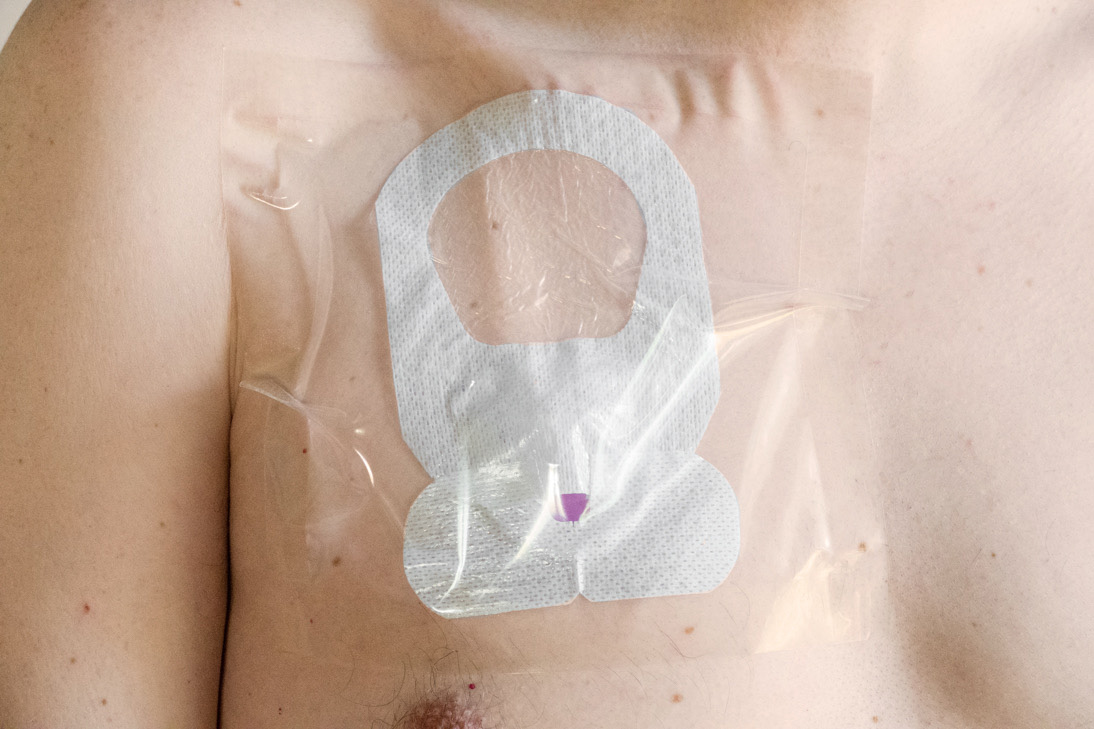
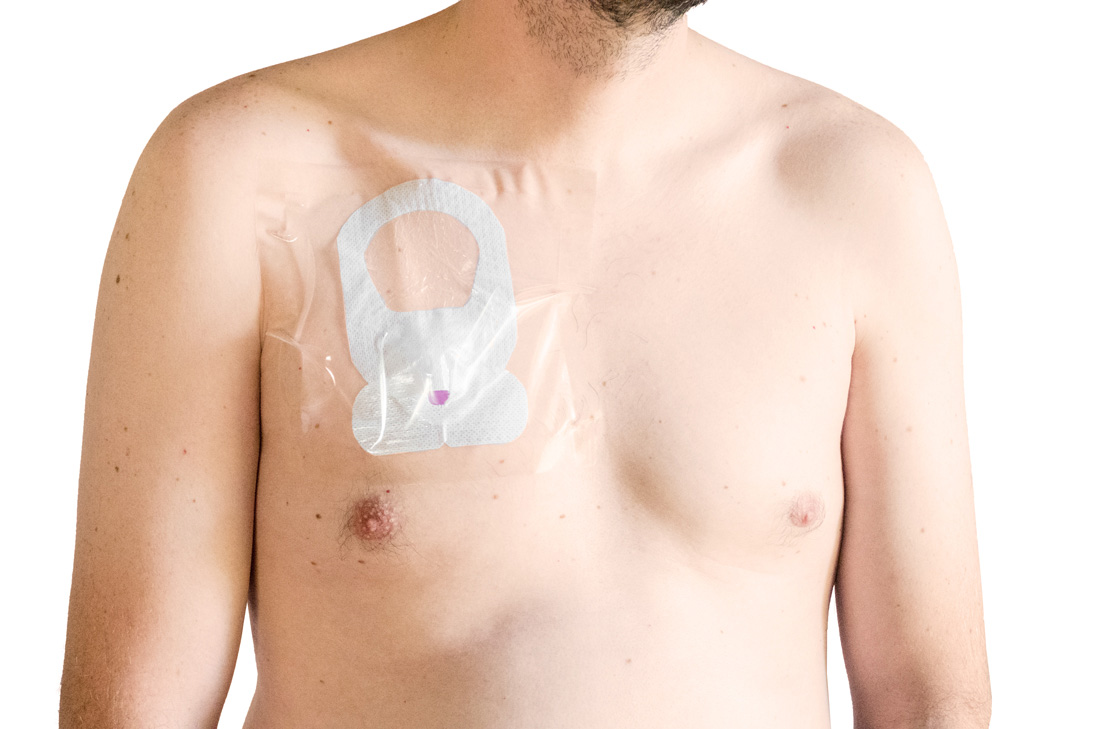
A port dressing on the chest is usually larger than a PICC dressing, and the needle and tubing add some height. A flat adhesive barrier is the most practical cover because the chest has no limb to slide a sleeve over.
The HydroSeal Protective Barrier is a clear, latex-free film with an adhesive border that seals to the skin around your dressing. It goes over the intact dressing; you never remove the sterile dressing to put it on. Because it is clear, you and your nurse can see the site the whole time. For most port dressings a 7" x 7" or 9" x 9" barrier fits, depending on how big the dressing is and whether the tubing is coiled under it. The HydroSeal size guide explains how to measure.
Applying a barrier over a port dressing
- Prepare the skin. The skin around the dressing should be clean and dry, with no lotion, body oil or sunscreen where the border will sit.
- Secure the tubing. Coil any tubing flat on top of the dressing so the barrier covers it. If tubing has to exit the cover to reach a pump, ask your nurse how they want that handled before you shower.
- Stick the top first. Peel the top release liner and press the edge to skin about an inch above the dressing.
- Smooth down, then stick the bottom. Let the film drape over the dressing and needle without stretching it tight, then peel the bottom liner and press it about an inch below.
- Seal the sides. Remove the two side liners and press the border firmly all the way around. Do not lift it to adjust; the adhesive is designed to be placed once.
- Shower with your back to the water. Let the spray hit your back and shoulders. Keep the shower brief and not too hot.
- Remove carefully. Towel the outside of the barrier dry, then peel slowly from one corner, pressing down on your skin as you go so you do not tug on the dressing or needle.
Showering between cycles
Once the needle is out and the small puncture has closed (your nurse will usually put a small bandage on it for the rest of the day), you can go back to normal showers. No cover is needed for a de-accessed, healed port.
A few things are still worth knowing:
- Wash over the port gently. There is no need to scrub it.
- Look at the skin over the port while you are drying off. It is a good daily check.
- If your port was placed recently, the insertion incision has its own rules until it heals. Our guide to keeping a surgical incision dry covers that stage.
Skin care during treatment
Chemotherapy and radiation can make skin dry, thin or sensitive, and that matters for anything adhesive. If you find a barrier irritates your skin, stop using it and tell your nurse. Keep moisturizer off the area where the border sticks on shower days, and apply it after you have removed the barrier and the skin is dry. Do not shave the chest to help a barrier stick.
If you are feeling weak or dizzy after infusion, a shower chair and a handheld shower head make it much easier to wash sitting down and to control where the water goes. Having someone nearby for your first shower after treatment is a reasonable precaution.
Call your care team if...
- The port dressing gets wet or lifts at any edge
- The needle feels loose, moves, or you see fluid leaking around it
- The skin over the port is red, swollen, hot or painful
- You have a fever or chills, which during chemo may need urgent attention
- Your neck, face or arm on the port side swells
Frequently asked questions
Can I take a bath with a port?
With a healed, de-accessed port, usually yes. With an accessed port, no. The site must not be submerged while the needle is in, even under a barrier.
What if I am on a home pump for several days?
Ask your team before your first shower. Many people on multi-day pumps sponge bathe and wash their hair at the sink. If your team approves a shower, the pump needs to stay outside the spray, and the dressing and tubing need an impermeable cover.
Does the barrier replace my dressing?
No. The barrier is a non-sterile moisture shield that goes over your sterile dressing for the length of the shower, then comes off.
My port isn't accessed but the area is sore. Is that normal?
Some tenderness after access is common, but pain, redness, swelling or warmth over the port should be reported to your oncology team.