
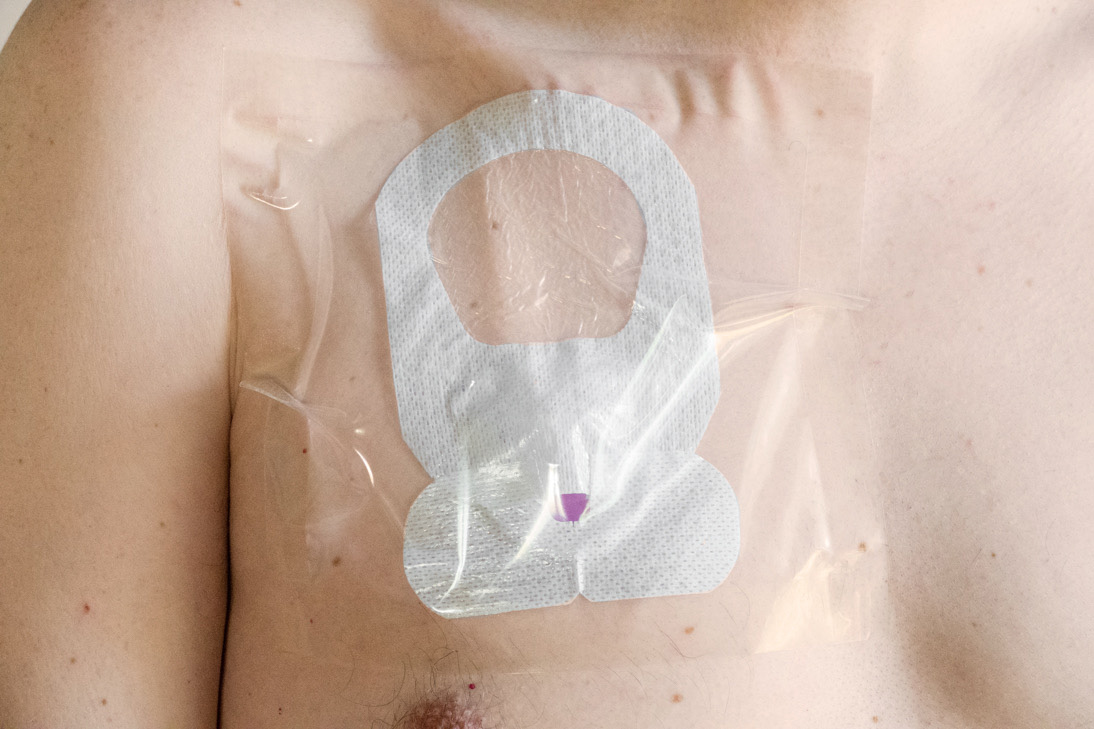
A Hickman line, Broviac line or other tunneled central line usually means a long stretch of treatment: chemotherapy, a stem cell transplant, long-term IV nutrition. It also tends to mean weeks of washing at the sink, because nobody explained how to shower with tubes coming out of your chest.
Many people with a tunneled line can shower, as long as the exit site, the dressing and the lumens stay dry and the team agrees. This guide covers how.
Quick answer: With your care team's OK, cover the exit site, the dressing and the coiled lumens with a large waterproof barrier that seals to dry skin all the way around. Keep your chest out of the direct spray and keep showers short. Never submerge the line: no baths, pools, hot tubs or the ocean.
What makes a tunneled line different
A tunneled line is a central venous catheter that runs under the skin of the chest for a few inches before it enters a vein. A small cuff under the skin helps anchor it. The point where it comes out of the skin is the exit site, and that is where the dressing goes.
Unlike a port, a tunneled line is always on the outside: one, two or three lumens hang from the exit site, each with a clamp and a cap. All of that has to stay dry and protected in the shower.
Rules vary more between hospitals for tunneled lines than for almost any other device. Some teams change the dressing routine once the exit site has fully healed. Others keep the same rules for the life of the line. Ask your team what they want before your first shower, and again if anything changes.
Choosing a barrier size
The barrier has to reach at least an inch past the dressing on every side and still cover the lumens folded up against your chest. For most tunneled lines that means a large barrier:
- 9" x 9" HydroSeal for a smaller dressing with lumens that coil neatly.
- 10" x 12" HydroSeal for a larger dressing, longer lumens, or a line placed low on the chest.
When in doubt, size up. Most leaks come from a barrier that is too small to seal past the edge of the dressing. The size guide explains how to measure.
Showering with a Hickman line, step by step
- Clamp and cap. Make sure every clamp is closed and every cap is on tight.
- Check the dressing. If it is lifting or damp, do not shower. Call your team.
- Coil the lumens flat against the dressing. Gently loop them so they lie inside the area the barrier will cover, without kinking or pulling at the exit site.
- Dry the skin around the dressing. Skip lotion and body oil on your chest on shower days.
- Apply the barrier. Peel the top tab and press it to skin about an inch above the dressing, then the bottom, then the sides. Smooth the border all the way around, paying attention to the lower edge where water runs.
- Turn your back to the spray. Let water run down your back and wash your front with a cloth, keeping it away from the barrier. A handheld shower head helps.
- Keep it short, five to ten minutes, and avoid very hot, steamy showers that soften adhesive.
- Pat the barrier dry, then peel it off slowly from a top corner, holding the lumens so they do not swing.
- Check the dressing and the exit site. Any dampness under the dressing means a call to your team.
When showering is not an option yet
Some teams ask patients to wash at the sink for the first days after placement, or while the exit site is still healing. A warm cloth, washing one area at a time and keeping well away from the dressing, keeps you comfortable until you are cleared.
Call your care team right away if...
- The dressing gets wet or comes loose
- You have a fever or chills, especially during or after a flush
- The exit site is red, swollen, painful or leaking
- A clamp or cap is damaged, or the line is cracked or leaking
- The line looks longer than before, or you can see the cuff
Frequently asked questions
Can I shower with a Hickman line during chemotherapy?
Many people can, with the team's OK and a properly sealed cover. If your blood counts are low, your team may have extra advice about water and hygiene, so ask.
Do I need to cover the lumens, or just the dressing?
Both. The caps and connections are an entry point too, so keep them clamped, capped and under the barrier.
Is this the same as showering with a dialysis catheter?
Very similar, but dialysis units often have their own rules. See showering with a dialysis catheter.